NORACT
Welcome to the homepage for the NORACT study.
You may have found this page because you or someone you know has given birth prematurely, or has been informed that there is a risk of preterm birth in a future pregnancy. Here you can read more about the background and purpose of the study, as well as what participation involves.
For the study, we are recruiting women who are planning a pregnancy or who are in very early pregnancy (before 10 weeks of gestation).
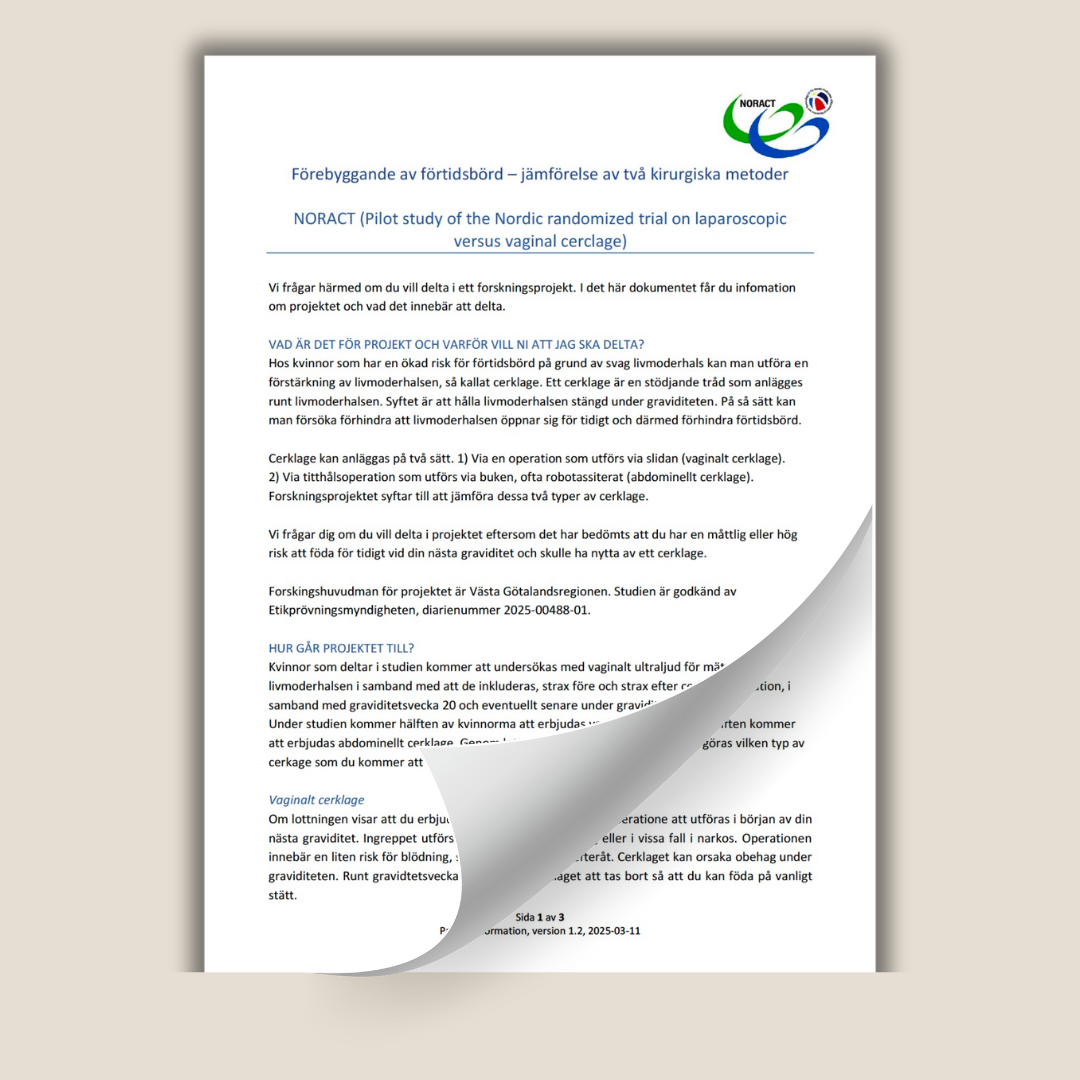
In the NORACT study, we compare two methods of placing a cerclage
(reinforcement of the cervix)
- Vaginal cerclage: performed through a surgical procedure via the vagina.
- Abdominal cerclage: performed through a laparoscopic procedure via the abdomen, often robot‑assisted.
On this page, you can find information about the study and contact details for the researchers conducting it.
NORACT is approved by the HRA, IRAS project ID: 327906
You can participate if
- You have a desire to become pregnant.
- Your doctor has assessed that you are at moderate to high risk of preterm birth in your next pregnancy due to a weakened cervix.
- The study physician believes that you may benefit from a cerclage, but cannot determine with certainty whether a vaginal cerclage or an abdominal cerclage would be the overall best treatment to prevent preterm birth in your next pregnancy.
- You are 18 years of age or older.
- You are able to read and understand the information about the study.
You cannot participate if
- Your obstetrician considers you unsuitable for participation.
- You are more than 10 weeks pregnant in your current pregnancy.
- You have a strong preference for one of the treatments over the other.
What does participation mean for me?
- Through randomization, it will be determined which type of cerclage you will be offered.
- Women participating in the study will undergo transvaginal ultrasound examinations to measure cervical length at inclusion, shortly before and shortly after the cerclage procedure, at around 20 weeks of gestation, and possibly later in pregnancy.
- Data from your cerclage procedure, your ultrasound examinations, and medical records relating to your ongoing pregnancy and the newborn child will be collected in a database accessible only to the researchers involved in the project.
Principal Investigator
Andrew Shennan
Professor of Obstetrics at King's College London
Department of Women and Children’s Health,
School of Life Course Sciences,
FoLSM, Kings College London
bo.jacobsson@obgyn.gu.se
Lokala forskara i projektet
Helena Karypidis,
Överläkare inom graviditet och förlossning
Akademiska sjukhuset Uppsala
helena.karypidis@akademiska.se
Och
Annie Lantto,
Biträdande överläkare inom gravidtet och förlossning
Skånes universitetssjukus Lund
annie.lantto@skane.se